 Curated by AS
Autopilot Pulse · #05 · 2026-09-03
Your website has two readers now
TL;DR
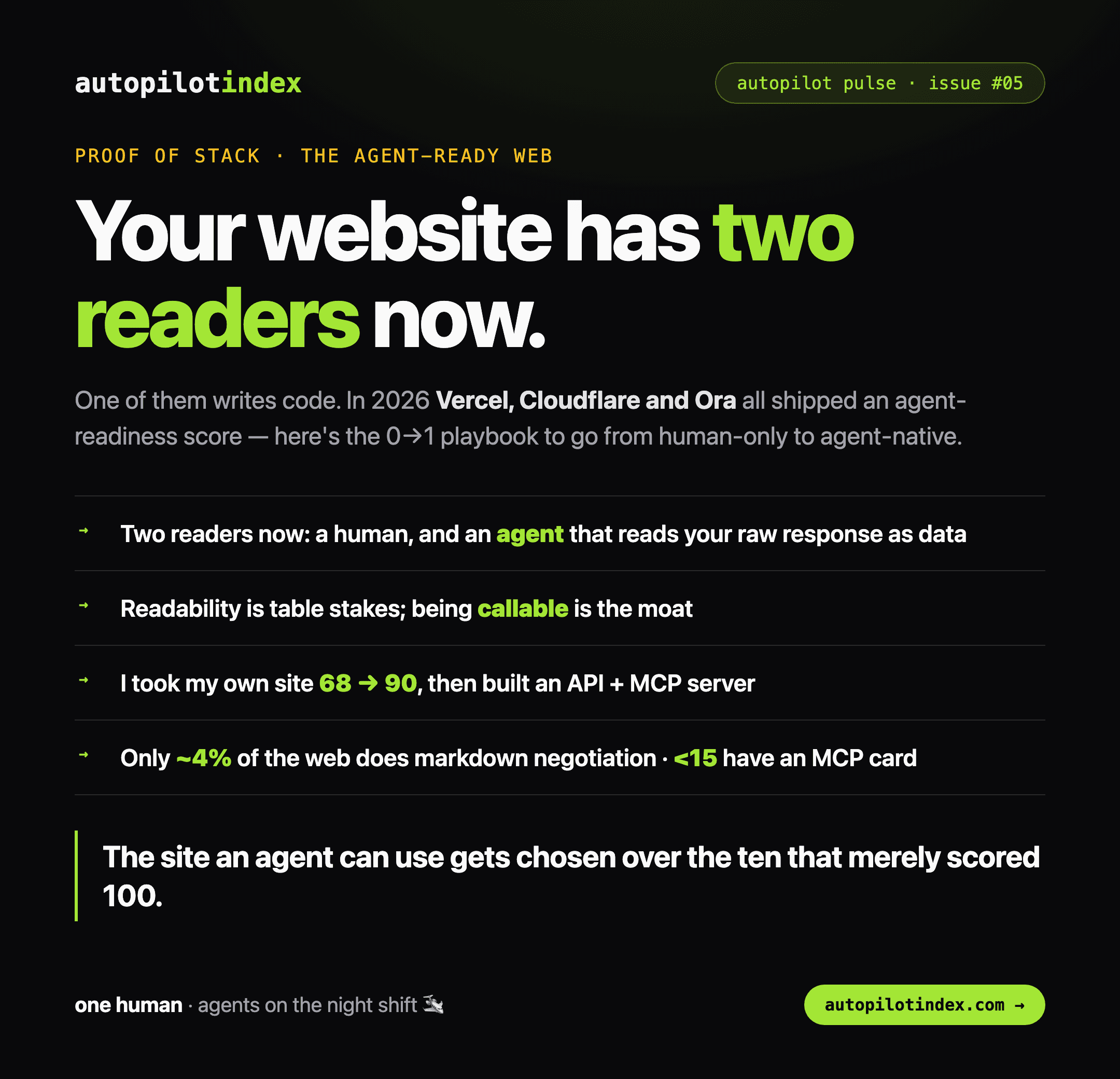
- →Your website has two readers now — a human, and an AI agent that reads your raw response as data and decides in one pass whether it can use you. In 2026 Vercel, Cloudflare and Ora all shipped a 0–100 agent-readiness score.
- →The graders disagree: behavioral (Ora/Vercel watch an agent attempt a task) vs protocol (Cloudflare — Web Bot Auth, MCP cards, agentic commerce) vs GEO (Glippy, aeojs). A 100 on one is not a 100 on another.
- →Readability is table stakes; being *callable* is the moat. Most of the web is invisible to agents — only ~4% do markdown content negotiation and fewer than 15 sites globally publish an MCP Server Card [HIGH].
- →I took my own site 68 → 90 in a day of fixes, then built a public API + MCP server so an agent can *use* the index, not just read it.
- →The full playbook — every grader compared, the six-category taxonomy, the L0→L5 ladder, the tiered 0→1 steps, and an agent-executable version — lives at autopilotindex.com/guides/agent-ready-web.
For most of the web's life it had one kind of reader: a human, with eyes, on a page. That assumption is quietly breaking. Your site now has a second reader — an AI agent, arriving with a task, reading your HTML as data, and deciding in seconds whether it can use you or should move on. Here's the shift, what I did about it on this very site, and the playbook to do it yourself.
You're reading the web copy of Autopilot Pulse #5.
Get the next edition by email. Free.
Confirm your email to join. Unsubscribe anytime.1 — Two infra giants built the same scoreboard
This year both Vercel and Cloudflare shipped a 0-to-100 agent-readiness score — Vercel's `is-agentic` (powered by Ora / Era Labs), Cloudflare's at isitagentready.com [HIGH]. When the two companies that route a huge share of the internet build the same scoreboard in the same year, it isn't a gimmick — it's a signal about where traffic is going.
They don't agree on what to measure. Ora and Vercel are behavioral — they send a real agent to complete a task on your live site and watch where it gets stuck. Cloudflare is protocol-first — it checks whether you speak the emerging standards (Web Bot Auth, Content Signals, MCP Server Cards, agentic commerce). GEO tools like Glippy and aeojs check AI-search visibility. A 100 on one is not a 100 on the others — which is exactly why a consensus view matters.
2 — The day of fixes (68 → 90)
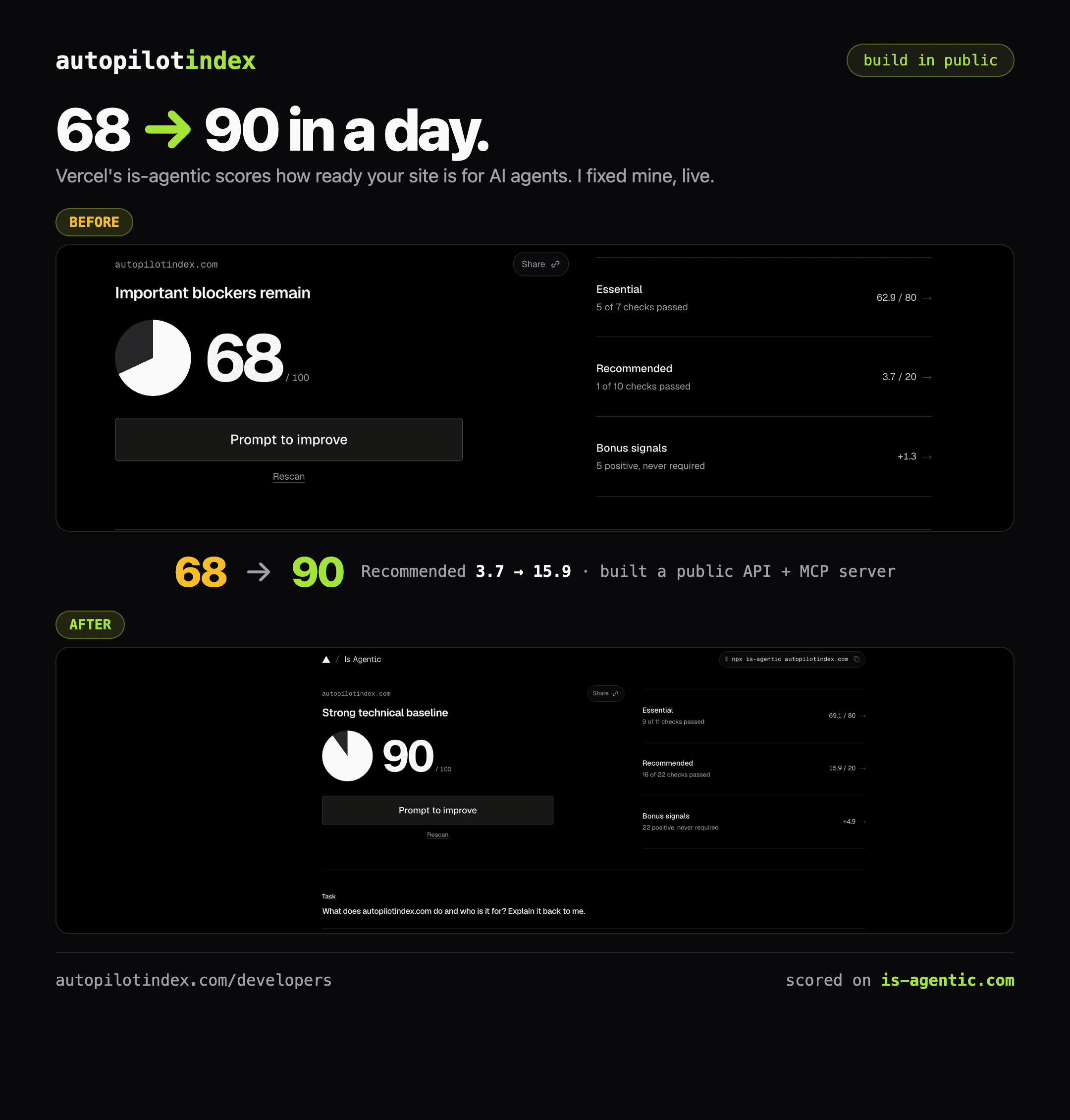
I ran it on this site and got 68/100 — "important blockers remain." Most of the gap closed in an afternoon, in public: a sitemap and an llms.txt with a "when to use this" section, JSON-LD so an agent can parse who I am, real About / Contact / Pricing pages (agents check these to decide you're legitimate), 404s that actually return 404, and markdown content negotiation.
That got me into the 80s. The uncomfortable framing from Cloudflare's own data: across the 200,000 most-visited domains, only ~3.9% support markdown negotiation and ~4% declare AI usage preferences [HIGH]. Most of the web is invisible to the second reader — so being early here is cheap and rare.
3 — Read vs use: the part most sites miss
The check I couldn't fake was the one that reframed everything: no API, no OpenAPI spec, no MCP server. It made me ask what an index is actually *for*. A human reads it. An agent should be able to call it.
So I built that: a public, read-only REST API, an OpenAPI 3.1 spec, and — the part that matters — an MCP server, so any agent can query the index natively. Security-hardened: read-only, whitelisted fields, validated inputs. The tell on how early this is: Cloudflare found fewer than 15 sites globally publish an MCP Server Card [MED]. Final score: 90/100 — "strong technical baseline." But the 90 isn't the win. The win is that the index went from something an agent can *read* to something an agent can *use*.
4 — What a builder should do about it
Ship the plumbing now — it's cheap and rare. Sitemap, llms.txt with when-to-use, JSON-LD, real trust pages, honest 404s. An afternoon of work that ~96% of the web hasn't done.
Decide what an agent should be able to *do*, not just read. If your product is data — a catalog, an index, a directory, docs — an API + MCP server turns it from a page an agent scrapes into a tool an agent calls. That's a different, more durable relationship.
Don't optimize the badge — optimize the outcome. A 100 doesn't mean an agent can complete a real task on your site. Fix the checks, then watch an agent actually try to use you. The full playbook — every grader compared, the maturity ladder, the tiered steps, and a version you can point Claude Code or Codex straight at — is at autopilotindex.com/guides/agent-ready-web. If you run a business on autopilot, what's the first thing you'd want an agent to *do* on your site — not just read?