 Curated by AS
Autopilot Pulse · #07 · 2026-09-10
The gate had no buyer
TL;DR
- →Distributional raised $30M and pivoted to Talaria Scientific in July 2026. This was a new mission within the same corporation, not the disappearance of the company.
- →Scott Clark’s accounts describe several obstacles: testing friction, difficulty acting on results, insufficient pre-deployment data and weak production adoption. No single cause is established by the post-mortem.
- →The company’s 2024 enterprise-testing essay already discussed developer autonomy and friction. It raises a useful question about the buyer, but it does not say to sell over developers’ heads.
- →Consolidation is real; the claim that the category vanished was too strong. In the six selected deal announcements below, three of five distinct buyers are incumbent infrastructure or security vendors. Arize’s $915M agreement was announced subject to closing.
- →My interpretation: verification is easier to justify when someone owns the consequences and can act on the result. That is a purchasing question to test, not a proven explanation for every company’s outcome.
In edition six I described a Veris stage demonstration in which an agent’s passing tests concealed an incorrect sanctions-screening implementation. That is a report of a particular demo, not a general benchmark of agent reliability.
The practical question carries into this edition: if checking an agent’s work matters, who will pay for it, and when? Distributional’s founder has offered an unusually useful account of trying to build that business.
You're reading the web copy of Autopilot Pulse #7.
Get the next edition by email. Free.
Confirm your email to join. Unsubscribe anytime.1 — A pivot, not a disappearance
Scott Clark founded Distributional in 2023 after building SigOpt, which Intel acquired in 2020. His published profile reports $30M raised for Distributional.
On July 24, 2026, Distributional announced its pivot to Talaria Scientific, a computational-science research harness. The announcement explicitly says it is the same Delaware corporation with the same investors.
The company had explored a sale and received offers. Clark’s subsequent personal account says most of the team landed together through one of the acquihire offers while the company continued with the pivot. Calling this a completely different company, or saying every offer was simply rejected, loses that distinction.
2 — Interest is not adoption
Clark distinguishes vision-market fit from product-market fit: enthusiasm for the problem can coexist with insufficient adoption of the product. His retrospective also describes scaling sales and operations before the product had earned that scale.
That is a useful operating distinction. A successful meeting records agreement; a deployment records a decision. A renewal records another one. Those are different kinds of evidence.
For a solo founder, the question is concrete: what did a customer put into regular use, what did it replace, and what would they miss if it disappeared? A compliment cannot answer those questions.
3 — Friction was one of several obstacles
The July announcement identifies resistance to tests that slow development, difficulty interpreting and acting on complex test results, and a market willing to deploy before rigorous testing.
Clark’s Berkeley talk recap also emphasises uncertainty about what to test and a lack of data before deployment. These accounts support a problem with readiness and actionability as well as friction. They do not establish how much each cause contributed.
A generated test can save writing time and still create investigation work. The relevant cost includes understanding a failure, deciding whether it matters and doing something about it. That is my explanation of a possible adoption barrier, not a measured result from Distributional’s customers.
4 — What the public evidence cannot establish
The earlier version of this edition argued that making a product free and locally installed removed every meaningful obstacle. That inference was too strong. Installation, integration, evaluation design, staff time and responsibility can remain expensive even when a licence costs nothing.
Nor can a repository’s star count establish enterprise usage, revenue or the absence of demand. I have removed that argument.
The question worth asking is what happened after a team tried the product: did it change a release decision, prevent repeat work or become part of routine operations? Public marketing pages cannot supply that conversion history.
5 — The earlier strategy document
On October 31, 2024, Nick Payton published Distributional’s case for enterprise-wide testing. The essay reports extensive conversations with enterprise AI leaders and describes teams’ freedom to choose tools and preference for low-friction development.
It argues for a consistent enterprise testing approach. It does not explicitly recommend selling over developers’ heads or mandating adoption; those were interpretations introduced by the earlier version of this article.
The tension is still worth examining. Who benefits from consistency across teams, and who absorbs the work of producing it? An enterprise-wide benefit needs a workable path through the teams that implement it. The essay makes that a fair question, not proof that the company knowingly chose the wrong buyer.
6 — My interpretation: accountability and actionability
My read is that accountability helps explain the buying problem. A team asked to add a gate needs a reason to accept the delay, and someone needs authority to fund the work. I do not have Distributional’s customer interviews or budget records, so this is a hypothesis rather than a reconstruction of its sales process.
Accountability alone is not enough. The result must support an action: change a prompt, choose another model, add a fallback, request human review or block a particular operation. An alert that nobody can interpret creates work without resolving a decision.
The practical standard is therefore stronger than identifying who gets blamed. Identify who owns the outcome, what decision the check changes and what evidence would justify its cost.
7 — Consolidation, with the terms kept straight
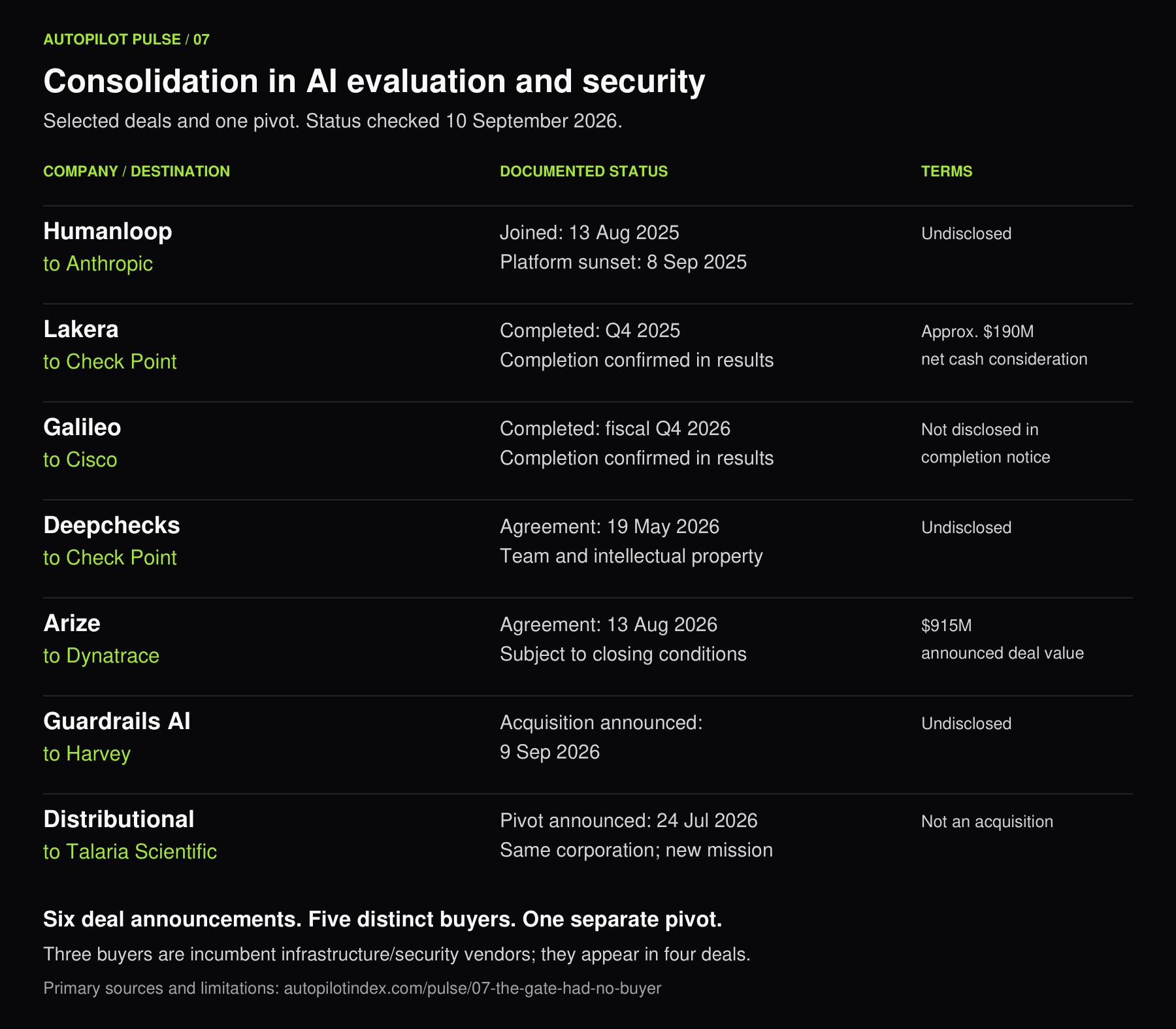
The following is a selected set of transactions across evaluation, observability and AI security, plus one separate pivot. These are overlapping markets, not a complete census of one uniform category.
Humanloop → Anthropic. Humanloop announced it was joining Anthropic on August 13, 2025 and set September 8 for its platform sunset. Its notice does not disclose financial terms or establish a precise team-only transaction structure.
Lakera → Check Point. Check Point’s full-year results confirm completion in the fourth quarter of 2025, for approximately $190M in net cash consideration. That is the disclosed accounting measure, not an interchangeable claim about headline valuation.
Galileo → Cisco. Cisco’s fiscal fourth-quarter 2026 earnings release confirms that the acquisition closed during that quarter. The cited completion notice does not disclose a price.
Deepchecks → Check Point. On May 19, 2026, Check Point announced a definitive agreement to acquire the team and intellectual property. The announcement provides no price. This edition uses that announced status rather than assuming completion or presenting a press estimate as confirmed consideration.
Arize → Dynatrace. On August 13, 2026, Dynatrace announced a definitive agreement valued at $915M, subject to closing conditions. I have not established a subsequent closing announcement as of this correction.
Guardrails AI → Harvey. Harvey’s announcement is dated September 9, 2026. It says the founders and team will join its product and engineering organisation. It does not establish that the product was retired.
Count the examples consistently: six deal announcements, five distinct buyers, and Distributional’s pivot counted separately. Three of those five buyers—Check Point, Cisco and Dynatrace—are incumbent infrastructure or security vendors. They appear in four of the six deal announcements. Neither count establishes a market-wide share.
- Humanloop: August 13, 2025 announcement and sunset notice
- Check Point: Lakera completion and net cash consideration
- Cisco: Galileo acquisition closed in fiscal Q4 2026
- Check Point: May 19 agreement for Deepchecks team and IP
- Dynatrace: August 13 agreement to acquire Arize
- Harvey: Guardrails acquisition announced September 9
8 — What acquisitions do and do not prove
Distributional’s July account describes the risk that established monitoring products could provide similar analytics within their existing offerings. That is a plausible reason to examine distribution and bundling.
But an acquisition alone cannot tell us whether a standalone business was impossible. It can reflect technology, talent, customers, strategic timing or a price the owners chose to accept.
The defensible conclusion is narrower: several buyers saw value in bringing these capabilities into broader organisations. Their purchases do not establish that the independent market has disappeared.
9 — The counterexamples belong in the argument
Braintrust and LangSmith continue to market evaluation and observability products. Their current product sites are enough to contradict the blanket assertion that nobody built a standalone offering.
They are not a controlled experiment against Distributional. Differences in timing, product scope, customers and distribution prevent a simple causal conclusion about developer-led versus enterprise-led sales.
I have removed the unverified funding comparisons and the claims that other vendors had shut down based on website errors. I have also removed the unsupported claim that several evaluation businesses all made the same pivot into training. Each would require its own dated evidence.
10 — Verification inside the work
Talaria’s published architecture describes a research loop with evidence checks, adversarial review, traceable records and user-controlled scientific judgments. It distinguishes exploratory work from stronger claims that require more scrutiny.
That is a documented design, not an independently verified performance result. It also does not mean Talaria has recreated Distributional’s exact testing mechanism.
The connection I find useful is architectural: verification sits inside a workflow that produces a research result. The check helps make an output usable. Whether that creates a durable business remains an open question.
11 — What to ask before handing work to agents
Name the outcome owner. Who decides whether the agent’s work is acceptable, and who can fund the checks? In a one-person business that may be you, but the responsibility still needs a name.
Connect each check to an action. Specify when a failure triggers a retry, a different tool, human review or a stop. Measure useful decisions, not just the number of tests.
Ask what you retain. A regression suite, reproducible environment or exportable evaluation history can remain useful when a vendor changes direction. Check portability and support terms before depending on a service.
Separate interest from repeated use. For your own product, look for customers using it again without another sales push. For a verification purchase, look for evidence that it improves the workflow you actually run.
Agents acting in real systems can make errors more concrete: an incorrect transaction, a failed customer task or an unauthorised change. My hypothesis is that these consequences can strengthen the case for verification. This edition’s evidence supports testing that hypothesis; it does not prove the buyer will always appear.